BEGINNERS
Looking for a Beginner Yoga Class in Sarzana?
If you want to start practising yoga but don’t know where to begin, beginner classes are the ideal starting point.
Beginners start learning yoga through the simplest poses. Gradually, they learn to understand their bodies, how they work, and how to develop different movement possibilities: engaging and relaxing the muscles, building muscle tone, lengthening the body, and improving mobility.
They also learn to understand the geometry of the poses and the terminology used by the teacher, while developing a greater awareness of their own limitations and potential: how far the arms and legs can move, how deeply the body can bend forward, extend backwards, or tilt sideways.
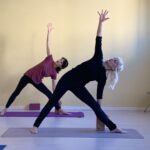
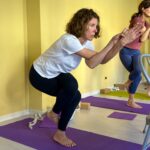
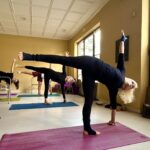
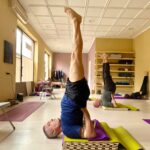
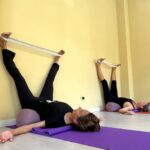
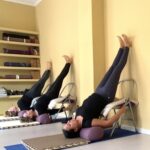
In beginner classes, all the main groups of poses are introduced gradually, always starting with the simplest variations: standing poses, forward bends, backbends, twists, and simple inversions, in which the head is positioned lower than the legs or pelvis.
Particular attention is given to standing poses, especially at the beginning of the learning process. They are essential for learning how to use the legs correctly and establish a stable, well-grounded foundation. This work forms the basis for approaching the other groups of poses later on with greater confidence and precision.
This video will give you a more detailed understanding of Iyengar Yoga. In my regular classes, I explain the asanas in greater detail and correct my students’ poses.
You can use this video to practise at home and keep fit. The suggested sequence is accessible to practitioners of all levels, including complete beginners, and is performed in real time, with my explanations of each asana.
This is a general practice that includes different types of asanas and is designed to help you maintain muscle tone, fitness and overall well-being.
INTERMEDIATE
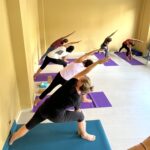
Intermediate-level practice introduces both more complex poses and more physically demanding work, including with asanas already familiar from beginner classes. The practice becomes more dynamic and challenging, while remaining precise and mindful. The intensity is always adapted to each practitioner’s individual characteristics and abilities.
At this level, dynamic sequences of asanas (vinyasa) and practices such as Surya Namaskar (Sun Salutation) may be introduced. These help develop strength, endurance, coordination and vitality. Inversions, such as Shirshasana, can also become part of the practice.
However, intermediate practice is not simply about performing more difficult asanas. Greater emphasis is placed on technique and precision of execution. Poses learned during the first months of practice are explored in greater depth, carefully observed and refined.
The aim is to progressively develop awareness, sensitivity and powers of observation, learning to understand more deeply how the body works within each asana.
BACK HEALTH / POSTURE
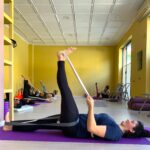
This specialised class is particularly suitable for people who suffer from back pain, have herniated or bulging discs, or experience lower back and neck pain. The practice is adapted to individual needs and uses specific props to make the poses accessible, comfortable and safe.
This practice differs from a regular yoga class: the asanas are carefully selected with spinal health in mind. Intense sequences are not included, and strenuous standing work is not required. The practice consists exclusively of poses that allow the spine to be worked with gradually and in a controlled manner, without overloading it.
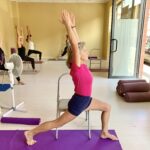
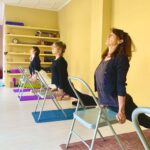
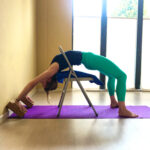
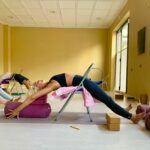
In Iyengar Yoga, a wide range of props and equipment is used to adapt asanas to each practitioner’s needs. Props help reduce the load on sensitive areas, maintain poses for longer, and work precisely with parts of the body that would otherwise be difficult to reach without support.
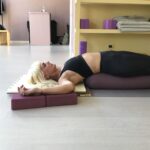
An important part of the practice involves gentle spinal stretches in a supine position, using props for support. This approach helps reduce compression on the spine and intervertebral discs, creating a feeling of greater space and bringing relief to the back.
Particular attention is paid to alignment and posture, which are essential for learning to use the back in a more balanced way in everyday life.
The goal is not to do more, but to do exactly what the back needs.
LONGEVITY & VITALITY / PRANAYAMA
Pranayama – Breathing, Calmness and Awareness
Some yoga poses and sequences have a relaxing and calming effect on the nervous system. Scientific research has shown that regular practice of yoga, meditation and certain breathing techniques may help reduce the body’s physiological response to stress, partly through changes in cortisol levels. Cortisol is one of the main hormones involved in the stress response.
Pranayama is the yogic discipline devoted to the regulation of the breath and, in the yoga tradition, to the management of vital energy (prana). It allows us to gradually develop greater awareness of our breathing and mental state.
Working with the breath can help slow the incessant flow of thoughts, calm mental agitation and develop a greater ability to remain present and centred. In this way, the practice can help us avoid reacting automatically to stressful situations and approach them with greater balance.
Yoga works on more than just the body. Regular practice can also have a profound influence on our mental and emotional state, fostering greater calm, stability and the ability to manage stress.
This is something I have experienced personally over many years of practice and continue to observe in my teaching today.
Would you like to learn more about the effects of yoga and pranayama on stress? → Read the scientific studies on my blog.